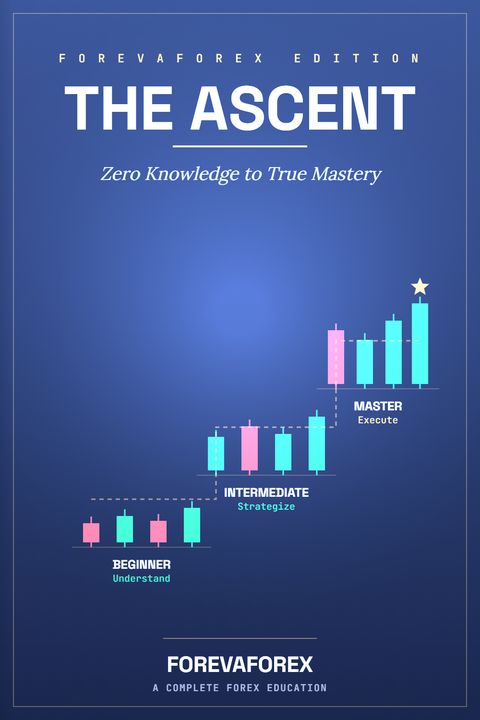
The Ascent
The complete ForevaForex curriculum in one book. It takes you from zero knowledge to true mastery in three levels, Beginner, Intermediate and Master, with lessons, diagrams, milestones and quizzes along the way.
It gives a new trader a clear order to learn things in, so you stop jumping between random videos. Every idea builds on the last, and the quizzes show you what has really sunk in.
What is inside (75 lessons)
| 01 | Beginner Foundations | 26 lessons |
| 02 | Intermediate Trading Skills | 26 lessons |
| 03 | Master Level Expertise | 23 lessons |
Free sample lesson: The History Of Forex
Foreign exchange did not begin as the fast, blinking, screen driven market it is today. It grew slowly out of centuries of merchants, empires, and travelers needing a reliable way to trade goods across borders that used entirely different coins and currencies. Picture a merchant in the 1800s arriving in a foreign port with a chest of coins from home, coins that meant nothing to the local baker or blacksmith until someone worked out exactly how much of the local currency they were worth. That basic problem, translating one country's money into another's, is the seed every modern forex trade grows from.
For most of modern history, currency values were tied to gold under what was called the gold standard, meaning a country's paper money was only worth as much gold as it could actually be exchanged for at a bank. That system held global exchange rates relatively fixed and predictable for decades, almost boringly stable by today's standards, but it also meant countries had very little room to maneuver during hard times. A government facing a recession or a war could not simply print more money or let its currency slide to make its exports cheaper, doing so would have broken the promise that every note could be redeemed for gold, and broken promises like that tend to trigger a run on a currency almost overnight.
The turning point came on August 15, 1971, when President Nixon announced that the United States would no longer convert dollars into gold on demand, an event now remembered as the Nixon Shock. It was meant as a temporary measure to protect America's gold reserves, but the temporary measure never really reversed. Within a few years, one major currency after another cut its own tie to gold, and by the mid 1970s most of the world's currencies were floating freely against each other for the first time in modern history, their values set purely by supply and demand rather than a fixed promise backed by a vault of gold bars.
That single decision, made in a matter of weeks, is the real starting point of the forex market as it exists today. Every price you will ever look at on a trading screen, every pip of movement in EUR/USD or USD/JPY, is a direct descendant of that choice to let money find its own value in the open market rather than pin it to something fixed. Understanding this history is not just trivia, it explains why forex behaves the way it does. It is not an arbitrary casino built on nothing, it is the natural result of currencies being set free to reflect the real economic story of the country behind them, updated in real time, every single day the market is open.
Keep reading The Ascent
Illustrated books, live tools and a practice hub. Free to start.